Module: FastPolylines
- Defined in:
- ext/fast_polylines/fast_polylines.c,
lib/fast_polylines/version.rb,
ext/fast_polylines/fast_polylines.c
Overview
Implementation of the Google polyline algorithm.
Install it with gem install fast-polylines, and then:
require "fast_polylines"

FastPolylines.encode([[38.5, -120.2], [40.7, -120.95], [43.252, -126.453]])
# "_p~iF~ps|U_ulLnnqC_mqNvxq`@"

FastPolylines.decode("_p~iF~ps|U_ulLnnqC_mqNvxq`@")
# [[38.5, -120.2], [40.7, -120.95], [43.252, -126.453]]
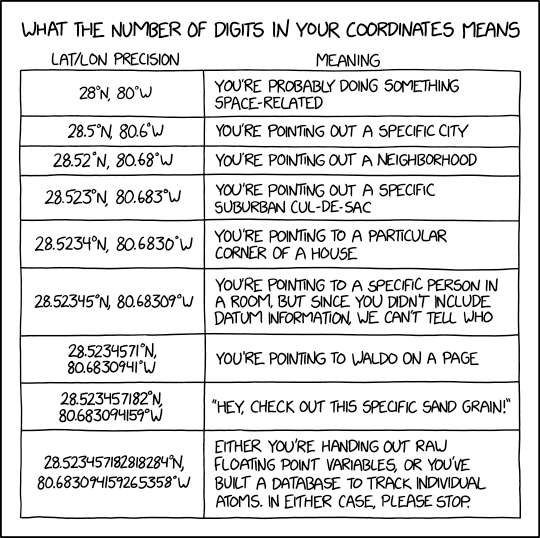
You can set an arbitrary precision for your coordinates to be encoded/decoded. It may be from 1 to 13 decimal digits. However, 13 may be too much.
Defined Under Namespace
Constant Summary collapse
- VERSION =
"2.2.2"
Class Method Summary collapse
-
.decode(polyline, precision = 5) ⇒ Array
Decode a polyline to a list of coordinates (lat, lng tuples).
-
.encode([[lat, lng], ...], precision = 5) ⇒ String
Encode a list of coordinates to a polyline, you may give a specific precision if you want to retain more (or less) than 5 digits of precision.
Class Method Details
.decode(polyline, precision = 5) ⇒ Array
Decode a polyline to a list of coordinates (lat, lng tuples). You may set an arbitrary coordinate precision, however, it must match the precision that was used for encoding.
78 79 80 81 82 83 84 85 86 87 88 89 90 91 92 93 94 95 96 97 98 99 100 101 102 103 104 105 106 107 108 109 110 111 112 113 114 115 116 |
# File 'ext/fast_polylines/fast_polylines.c', line 78 static VALUE rb_FastPolylines__decode(int argc, VALUE *argv, VALUE self) { rb_check_arity(argc, 1, 2); Check_Type(argv[0], T_STRING); char* polyline = StringValueCStr(argv[0]); uint precision = _get_precision(argc > 1 ? argv[1] : Qnil); double precision_value = _fast_pow10(precision); VALUE ary = rb_ary_new(); // Helps keeping track of whether we are computing lat (0) or lng (1). uint8_t index = 0; size_t shift = 0; int64_t delta = 0; VALUE sub_ary[2]; double latlng[2] = {0.0, 0.0}; // Loops until end of string nul character is encountered. while (*polyline) { int64_t chunk = *polyline++; if (chunk < 63 || chunk > 126) { rb_raise(rb_eArgError, "invalid character '%c'", (char)chunk); } chunk -= 63; delta = delta | ((chunk & ~0x20) << shift); shift += 5; if (!(chunk & 0x20)) { delta = (delta & 1) ? ~(delta >> 1) : (delta >> 1); latlng[index] += delta; sub_ary[index] = rb_float_new((double) latlng[index] / precision_value); // When both coordinates are parsed, we can push those to the result ary. if (index) rb_ary_push(ary, rb_ary_new_from_values(2, sub_ary)); // Reinitilize since we are done for current coordinate. index = 1 - index; delta = 0; shift = 0; } } return ary; } |
.encode([[lat, lng], ...], precision = 5) ⇒ String
Encode a list of coordinates to a polyline, you may give a specific precision if you want to retain more (or less) than 5 digits of precision. The maximum is 13, and may really be too much.
143 144 145 146 147 148 149 150 151 152 153 154 155 156 157 158 159 160 161 162 163 164 165 166 167 168 169 170 171 172 173 174 175 176 177 178 179 180 181 182 183 184 185 186 187 188 189 190 191 192 193 194 195 196 197 198 199 200 201 202 203 204 |
# File 'ext/fast_polylines/fast_polylines.c', line 143 static VALUE rb_FastPolylines__encode(int argc, VALUE *argv, VALUE self) { rb_check_arity(argc, 1, 2); Check_Type(argv[0], T_ARRAY); size_t len = RARRAY_LEN(argv[0]); uint64_t i; VALUE current_pair; int64_t prev_pair[2] = {0, 0}; uint precision = _get_precision(argc > 1 ? argv[1] : Qnil); dbg("rb_FastPolylines__encode(..., %u)\n", precision); rdbg(argv[0]); double precision_value = _fast_pow10(precision); // This is the maximum possible size the polyline may have. This // being **without** null character. To copy it later as a Ruby // string we'll have to use `rb_str_new` with the length. dbg("allocated size: %u * 2 * %lu = %lu\n", MAX_ENCODED_CHUNKS(precision), len, MAX_ENCODED_CHUNKS(precision) * 2 * len); char *chunks = malloc(MAX_ENCODED_CHUNKS(precision) * 2 * len * sizeof(char)); size_t chunks_index = 0; for (i = 0; i < len; i++) { current_pair = RARRAY_AREF(argv[0], i); uint8_t j; Check_Type(current_pair, T_ARRAY); if (RARRAY_LEN(current_pair) != 2) { free(chunks); rb_raise(rb_eArgError, "wrong number of coordinates"); } for (j = 0; j < 2; j++) { VALUE current_value = RARRAY_AREF(current_pair, j); switch (TYPE(current_value)) { case T_BIGNUM: case T_FLOAT: case T_FIXNUM: case T_RATIONAL: break; default: free(chunks); rb_raise(rb_eTypeError, "no implicit conversion to Float from %s", rb_obj_classname(current_value)); }; double parsed_value = NUM2DBL(current_value); if (-180.0 > parsed_value || parsed_value > 180.0) { free(chunks); rb_raise(rb_eArgError, "coordinates must be between -180.0 and 180.0"); } int64_t rounded_value = round(parsed_value * precision_value); int64_t delta = rounded_value - prev_pair[j]; prev_pair[j] = rounded_value; // We pass a pointer to the current chunk that need to be filled. Doing so // avoid having to copy the string every single iteration. chunks_index += _polyline_encode_number(chunks + chunks_index * sizeof(char), delta); dbg("%s\n", chunks); } } dbg("final chunks_index: %zu\n", chunks_index); VALUE polyline = rb_str_new(chunks, chunks_index); free(chunks); return polyline; } |