RailsApiDoc
Installation
Add this line to your application's Gemfile:
gem 'rails_api_documentation'
And then execute:
$ bundle
Or install it yourself as:
$ gem install rails_api_documentation
Features
- displaying application api if used in one of correct ways
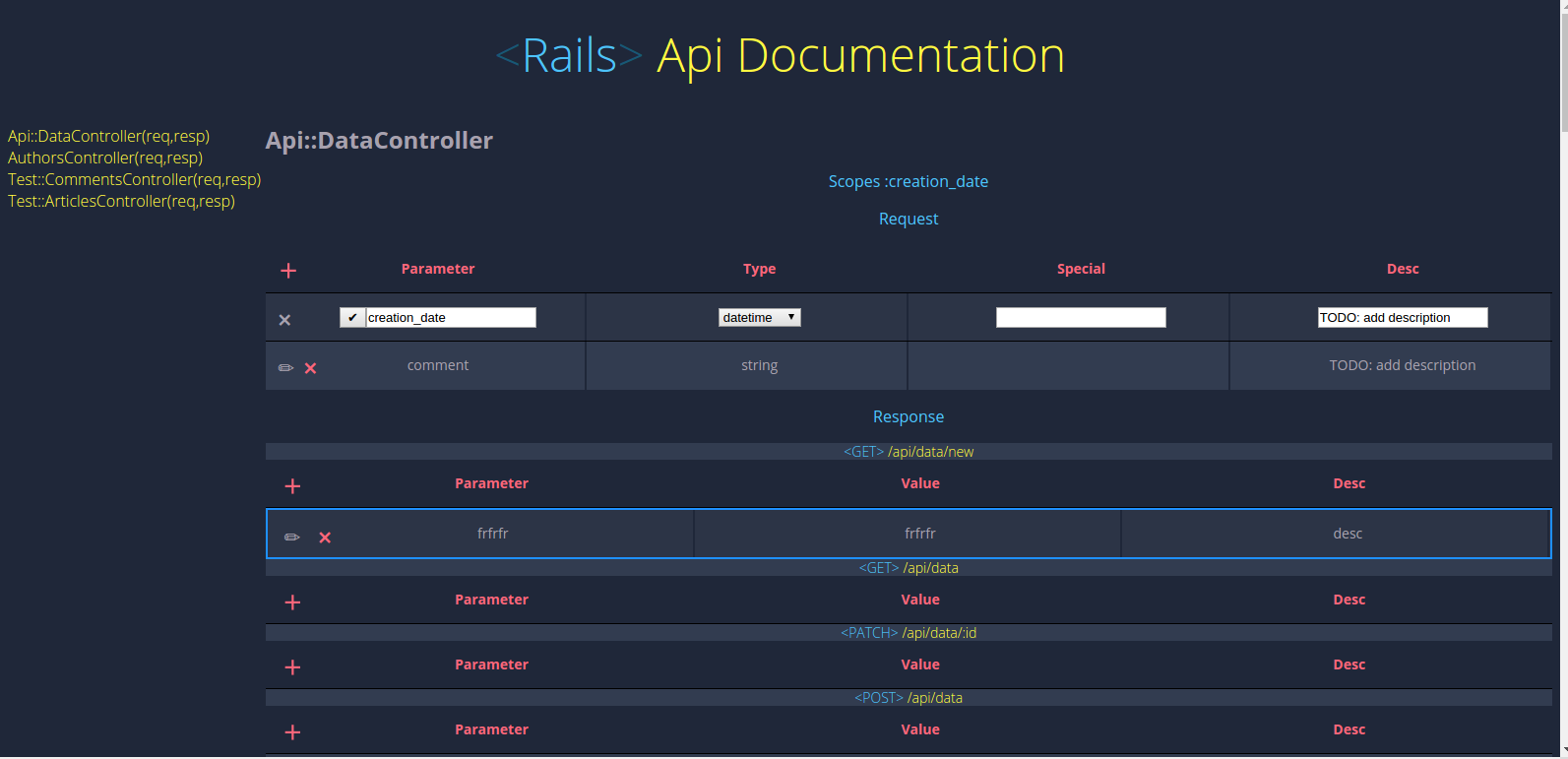
- Integration with Rabl if it is bundled
strong_paramsmethod that will filter incoming params for you
Usage
To display api documentation on route '/api_doc' you need to:
- config/application.rb ->
ruby
require 'rails_api_doc'
config/routes.rb ->
mount RailsApiDoc::Engine => '/api_doc'define request parameters. Example:
class AuthorsController < ApplicationController

  has_scope :article_id, :name

  # Define parameters with type and nested options
  # Article and Datum are usual ActiveRecord models
  parameter :age, type: :integer
  parameter :name, type: :string, required: true
  parameter :articles_attributes, type: :ary_object, model: 'Article' do
    parameter :title, type: :string
    parameter :body, type: :string, required: true
    parameter :rating, type: :enum, enum: [1, 2, 3]
    parameter :data_attributes, type: :object, model: 'Datum' do
      parameter :creation_date, type: :datetime
      parameter :comment, type: :string
    end
  end
  parameter :test, type: :string, required: true

  parameter({
    articles_attributes: { model: 'Article', type: :ary_object },
    data_attributes: { model: 'Datum' },
    comments_attributes: { model: 'Comment', type: :ary_object }
  }, type: :object) do
    parameter :id
    parameter :name
  end

end
go to localhost:3000/api_doc
Strong params
You may want to use your defined request api to filter incoming parameters.
Usually we use something like params.permit(:name, :age), but no more!
With this gem bundled you can do this:
    parameter :body, type: :string
    parameter :title, type: :string

    # controller action
    def create
      Comment.create!(strong_params)
    end
and if request is POST '/comments', params: { body: 'Comment body', title: 'Comment title', age: 34 }
Comment will be created with: Comment(body='Comment body', title='Comment title', age=nil)
Value
You can pass optional value argument to every parameter:
parameter :val, type: :integer, value: -> (request_value) { 5 }
on every matching request value in this field will be overriden by value returned by proc.
value field expecting anything that will respond to :call and can accept one argument(param value from request)
you should expect that value passed can be nil
This can be used to force values on some fields, or modify values passed to request in some ways.
E.g. you want to force current_user_id on model creation instead of passing it from frontend.
Enum
When you defined parameter type as :enum you can pass enum: option. This will filter parameter by values provided.
Group common blocks
You can define parameters that have common fields this way:
    parameter({
      articles_attributes: { model: 'Article', type: :ary_object },
      data_attributes: { model: 'Datum' },
      comments_attributes: { model: 'Comment', type: :ary_object }
    }, type: :object) do
      parameter :id
      parameter :name
    end
Pass common values as last optional arguments and uniq definitions as hash value. All nesting parameters are applied to elements in blocks.
Something with same type can be defined like this:
parameter :name, :desc, type: :string
Types
Parameter type may be one of these:
   # Non nested
    :bool - Boolean type, accepts true, false, 'true', 'false'
    :string - will accept anything beside nested type
    :integer - accepts numbers as string value, and usual numbers
    :array - array of atomic values (integer, strings, etc)
    :datetime - string with some datetime representation accepted by DateTime.parse
    :enum - one of predefined values of enum: option (only atomic types)

   # nested
    :object - usual nested type. comes very handy with rails nested_attributes feature
    :ary_object - array of :object type, rails nested_attributes on has_many
TODO's
type for id reference with model field to display associated model and CONTROLLER in params for linking
native DSL for defining response
action :show do
response :age, type: Integer
response :name, type String
response :data, type: :model, model: Datum do
  response :creation_date, type: DateTime
  response :comment, type: String
end
end
native DSL for defining scopes
scope :age, desc: 'Filters authors by given age'dsl for extending response parameters
response :data, type: :model, model: Datum do
extends DataController, action: :show
end
dsl for extending request parameters
parameter :data, type: :model, model: Datum do
extends DataController, action: :show
end
ability to split request params to actions(low prior)
CRUD for all parameters
merging parameters from all sources before display
pull everything that's possible to config
Development
- add specs for everything done
- inline documentation
- README FAQ on added functionality with examples
License
The gem is available as open source under the terms of the MIT License.