Caddy 



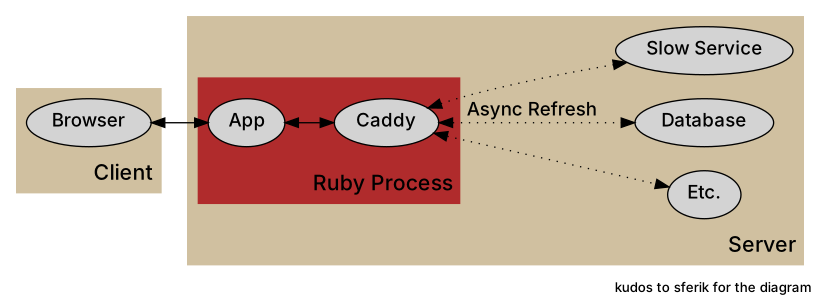
Caddy is an asynchronously refreshed cache that is updated on an interval to store objects that you can access quickly during requests.
Caddy is great for storing information like feature flags – accessed extremely frequently during many requests, updated relatively rarely and usually safe to be stale by some small duration.
It’s powered by concurrent-ruby, a battle-tested and comprehensive thread-based (& thread-safe) concurrency library.
```ruby # in your initializers (caddy.rb would be a wonderful name) Caddy[:flags].refresher = lambda do SomeFlagService.fetch_flags # this can take a few seconds; it won’t block requests when you use it later end
you can have multiple cache stores, refreshed at different intervals
Caddy[:cache_keys].refresher = lambda do SomeCacheKeyService.cache_keys end
Caddy[:flags].refresh_interval = 30.seconds # default is 60 seconds; the actual amount is smoothed slightly # to avoid a stampeding herd of refreshes Caddy[:cache_keys].refresh_interval = 5.minutes
… after your application forks (see the guide below for Unicorn, Puma & Spring)
Caddy.start
… in a controller
def index # Caddy provides a convenience method to access the cache by key; you can also access # what your refresher returns directly with Caddy[:flags].cache if Caddy[:flags][:fuzz_bizz] Rails.cache.fetch(“#Caddy[:cache_keys][:global_key]/#Caddy[:cache_keys][:index_key]/foo/bar”) do # wonderful things happen here end end end ```
Error handling
As Caddy refreshers are run in threads, exceptions are not normally reported (except by default in the logs). If your refresher errors out (or times out, which can happen if your refresher takes as long as your refresh interval to run) your error handler will be called and the cache value will remain what it was before it errored. This means your application may use stale values until your refresher stops erroring.
To add a programmatic error handler:
ruby
Caddy[:flags].refresher = -> { SomeFlagService.fetch_flags }
Caddy.error_handler = -> (exception) { ExceptionReporter.bad_thing_happened(exception) } # global (all caches) error handler
Caddy[:flags].error_handler = -> (exception) { SpecificExceptionReporter.worse_thing_happened(exception) } # cache-specific error reporters also supported
Using Caddy with Unicorn
Start Caddy after fork:
```ruby # in your unicorn.rb initializer after_fork do |server, worker| Caddy.start
# … your magic here end ```
Using Caddy with Puma
Start Caddy after the worker boots:
```ruby # in your puma.rb initializer on_worker_boot do |server, worker| Caddy.start
# … your magic here end ```
Using Caddy with Spring
Start Caddy after fork:
```ruby # in your caddy.rb initializer, perhaps
if Rails.env.development? && defined?(Spring) Spring.after_fork do Caddy.start end end ```
Give it to me!
Add this line to your application’s Gemfile:
ruby
gem "caddy"
Semantic Versioning
This project conforms to semver. As a result of this policy, you can (and should) specify a dependency on this gem using the Pessimistic Version Constraint with two digits of precision. For example:
ruby
spec.add_dependency "caddy", "~> 1.0"
This means your project is compatible with caddy 1.0 up until 2.0.
Contributing
- Fork it
- Create your feature branch (
git checkout -b my-new-feature) - Commit your changes (
git commit -am 'Add some feature') - Push to the branch (
git push origin my-new-feature) - Create new Pull Request
Don’t forget to run the tests with rake.