Mortadella for Ruby


Mortadella for Ruby makes it easy to programmatically build data tables that can
be compared to Cucumber for Ruby
tables through cucumber_table.diff! mortadella_table.
You want to do this as much as possible. Cucumber for Ruby has very powerful built-in facilities to visualize where and how two tables differ:
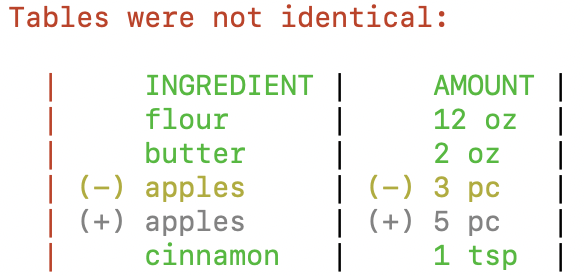 Oh no, our algorithm selected too many apples!
Installation
- add
gem 'mortadella'to yourGemfile - run
bundle install
Usage
Mortadella supports horizontal and vertical Cucumber tables.
Horizontal Tables
-
In your cucumber spec, define the expected data in table form
Then I have these ingredients | INGREDIENT | AMOUNT | | flour | 12 oz | | butter | 2 oz | | apples | 3 pc | -
in the step definition for this, build an equivalent Mortadella table with the actual data, and diff the Cucumber table with the expected data against it.
Then /^I have these ingredients$/ do |expected_ingredients| actual_ingredients = Mortadella::Horizontal.new headers: ['INGREDIENT', 'AMOUNT'] actual_ingredients << ['flour', '12 oz'] # This data should come from your app actual_ingredients << ['butter', '2 oz'] # This data should come from your app actual_ingredients << ['apples', '3 pc'] # This data should come from your app expected_ingredients.diff! actual_ingredients.table end -
you can also dry up repetitive fields for better readability:
| DAY | ACTIVITY | | Monday | mowing | | | musing | | Tuesday | typing | | | tutoring | -
or filter the columns of your finished table by calling keep_matching_columns
Vertical Tables
-
In your cucumber spec, define the expected data in table form
Then my pie conforms to these specs: | WEIGHT | 2 lbs | | PORTIONS | 8 | | CALORIES | 500 | -
in the step definition for this, build an equivalent Mortadella table with the actual data, and diff the Cucumber table with the expected data against it.
Then /^My pie has these metrics:$/ do |expected_metrics|
  actual_metrics = Mortadella::Vertical.new
  actual_metrics['WEIGHT'] = '2 lbs'   # This data should come from your app
  actual_metrics['PORTIONS'] = 8       # This data should come from your app
  actual_metrics['CALORIES'] = 500     # This data should come from your app
  expected_metrics.diff! actual_metrics.table
end
API Reference
Horizontal Tables
new(headers:, dry: [])- Create a new horizontal table with column headers<<(row)- Add a row to the tableempty?- Check if the table has no data rowskeep_matching_columns(columns)- Filter table to only keep specified columnstable- Access the raw Cucumber-compatible table array
Vertical Tables
new- Create a new empty vertical table[key] = value- Add a key-value pair to the tableempty?- Check if the table has no rowskey?(header)- Check if a header exists in the tableto_h- Convert the table to a Ruby hashtable- Access the raw Cucumber-compatible table array